Palace to Palace on India's War Horse: Riding Rajasthan on the Marwari
 Cindi Sanden
Every post in this horseback series has been about riding out into a place instead of being led around in a line. Rajasthan adds something none of the others have. You do it on a horse that a king would have gone to war on, and you sleep in the forts and palaces that king would have called home.
This is the palace-to-palace ride, on the rare Marwari horse, across the desert state of northwest India. It is exotic and genuinely royal, and the horse itself is the reason to go.
The horse with the curled ears
The Marwari is unlike any horse you have ridden. The giveaway is the ears - they curve inward so far that the tips can rotate a full 180 degrees and actually touch each other when the horse is alert. The breed comes from the Marwar region around Jodhpur, and for centuries it was the war horse of the Rathore Rajput cavalry, bred from the twelfth century for courage, loyalty, and the stamina to cross open desert at speed.
Here is the part that gets me. The breed almost disappeared. By 1950 the Marwari was nearly extinct, kept going by only a handful of bloodlines. It came back because a British horsewoman named Francesca Kelly and an Indian nobleman named Raghuvendra Singh Dundlod teamed up in the 1990s to save it. They built the first stud book, founded the Indigenous Horse Society of India, and started a breeding program called Marwari Bloodlines. There are still only about two thousand registered Marwaris in the world today. When you ride one, you are riding a horse that history very nearly lost.
They are forward-going, sensitive, and smart, bred to move out and cover ground. That is exactly what makes them a joy under saddle for the right rider, and it is also why this is not a nose-to-tail pony ride.
The days: palace to palace across the Aravalli foothills
A typical safari runs about seven nights and moves you point to point along the foothills of the Aravalli Hills, roughly twenty-five to thirty-five kilometers a day, four to six hours in the saddle with a picnic lunch and a siesta through the heat of the afternoon. You are not looping back to the same barn. You ride from one heritage property to the next, retracing old routes between forts and country palaces.
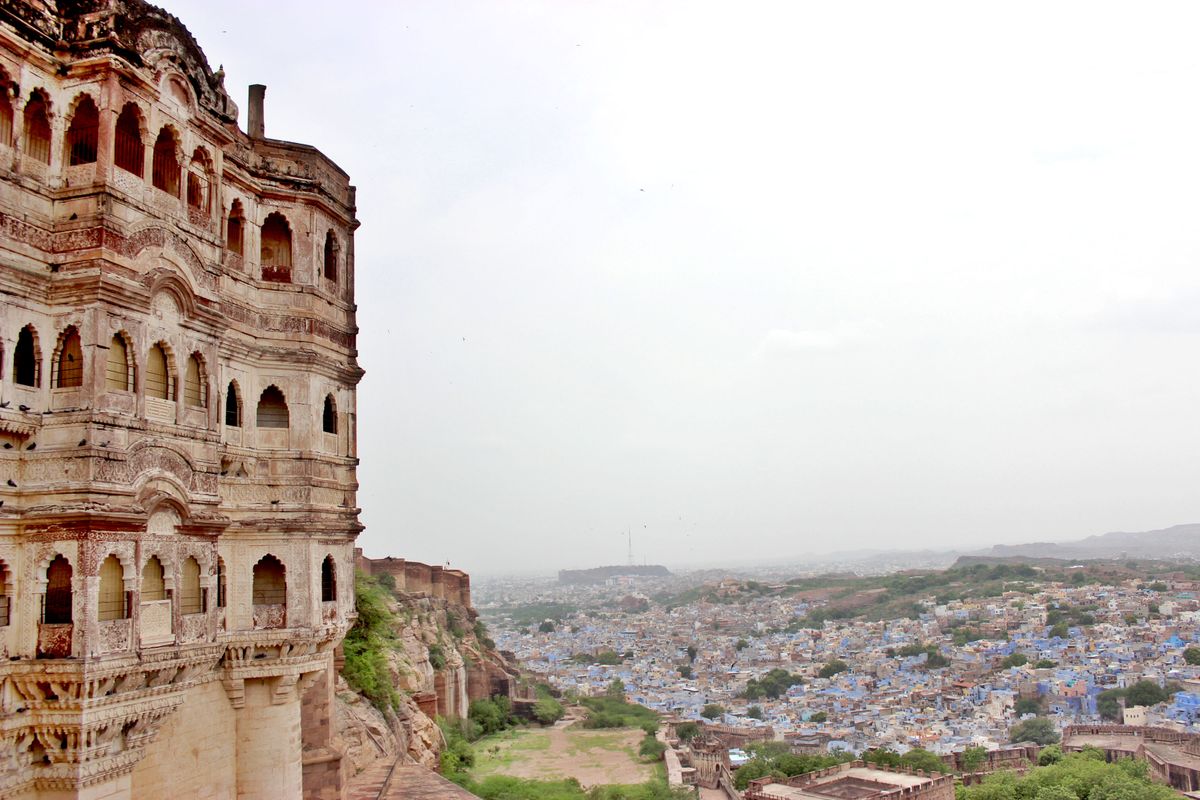
The landmarks along the way are the real thing. Rides pass the towering Mehrangarh Fort above Jodhpur, the fifteenth-century Kumbhalgarh Fort with its wall that runs thirty-six kilometers (second only to the Great Wall of China), and the astonishing marble Jain temple at Ranakpur. In between it is open country. Fields, dunes, little villages where children run out to see the horses, and the occasional antelope or wild peacock.
The nights: candlelight in a fort, stars over the desert
Where you sleep is half the trip. Some nights you are in a converted fort or a small family palace, dining by candlelight in a courtyard that has been in the same family for generations. Other nights you are in a proper tented camp, and by that I do not mean roughing it. Think comfortable canvas tents with real beds, linens, and their own washing facilities, set up out in the desert under an enormous sky.
One place worth knowing by name is Dundlod Fort, up in the Shekhawati region. It dates to the seventeenth century, became a heritage hotel in 1982, and has been the home base of Marwari horse safaris since 1985. It is the same family that helped save the breed. Its Royal Equestrian and Polo Centre is the only horse safari center in India affiliated with the country's Equestrian Federation.
Time it for the Pushkar Fair
If you can go in November, aim for the Pushkar Fair. It is a five-day camel and livestock fair in the town of Pushkar and one of the largest of its kind anywhere, with well over eleven thousand camels and horses brought in to trade alongside some two hundred thousand people. The Marwari horses are a headline attraction. Some safaris are built specifically to ride into the fair across the Thar Desert on the final day, arriving the way traders have for generations. In 2026 the fair runs roughly November 17 to 25, peaking on the full-moon night.
A version that gives back
There is one more way to do this ride that I love. An outfit called Relief Riders International has run Marwari safaris through Rajasthan since 2004 that pair the riding with humanitarian work. The group carries medical care, books, and school supplies to the rural villages along the route. Since it started it has reached more than twenty-five thousand people, most of them children. If the idea of a trip that leaves something behind speaks to you, this is a real and well-established way to do it.
Who this is really for
The honest part, same as every post in this series. The multi-day palace-to-palace safari is for confident intermediate riders and up. The Marwari is spirited and forward, the days are long and hot, and you will trot and canter across open country, so you want to be genuinely comfortable at all paces before you go. The riding season is the cool, dry stretch from October to March, because Rajasthan in summer is punishing.
If you are newer in the saddle but the breed has your heart, there is still a way in. Shorter rides around the dunes near Jodhpur, or a few days based at a single fort, let you meet the Marwari and ride the desert without committing to the full point-to-point distance. Tell me where you honestly are as a rider and I will steer you to the right version.
How we book it
Rajasthan is a specialist trip, and the right operator matters enormously, both for the quality of the horses and for making sure the itinerary matches your riding level. That part is mine to handle. Tell me whether you want the full palace-to-palace safari, the Pushkar Fair timing, or the give-back version, and how rugged or how gentle you want it, and I will build the right trip around you.
If a king's war horse and a week of forts and desert sounds like your kind of adventure, email me or send me a DM and let's talk. And if you are still weighing Rajasthan against the rest of the world, the full series recap puts every ride in one place, sorted by skill level and dream.
Talk soon, Cindi