Gallop Among Giraffes: The African Riding Safari
 Cindi Sanden
Of everything we dug up for this horseback series, the African riding safari is the one I cannot stop thinking about.
I have been on safari. I have done the game drives, the sundowners, the whole beautiful thing, and I would recommend it to anyone. But there is a version of safari that most people have never even heard of, and once you see it you cannot unsee it. Instead of watching the animals from a vehicle, you are out among them on horseback. No engine. No metal box. Just you, a horse, and a herd of zebra deciding whether to run alongside you.
Here is the thing that surprised me most in the research: the animals react to a horse completely differently than they do to a truck. A horse reads as another animal, not a machine, so the wildlife often lets you get astonishingly close before moving off. You become part of the landscape instead of an audience to it.
Let me tell you about the two rides at the very top of the list.
Botswana: Cantering the Okavango Delta
The Okavango Delta is one of the last great wildernesses on the planet, a massive inland delta in Botswana that floods every year and fills with wildlife. And it turns out one of the very best ways to experience it is from the saddle.
You ride out across the floodplains, water spraying up around the horses' legs, moving through herds of red lechwe, zebra, wildebeest, and giraffe. There are elephants. There are hippos and lions in the wider ecosystem, which is exactly why this is not a beginner ride (more on that in a minute). The camp that kept coming up as the gold standard is Macatoo, run by African Horseback Safaris. It is genuinely luxurious, the horses are superb, and you can go out for as many days as you like, riding morning and afternoon with siestas and long lunches in between.
The image that sold me: cantering across the open delta with a herd of giraffe loping along beside you, completely unbothered, because to them you are just one more animal moving through. I did not know that was something a person could actually do until we started this research.
Kenya: Riding With the Migration in the Masai Mara
If the Okavango is about water and grace, the Masai Mara is about sheer drama.
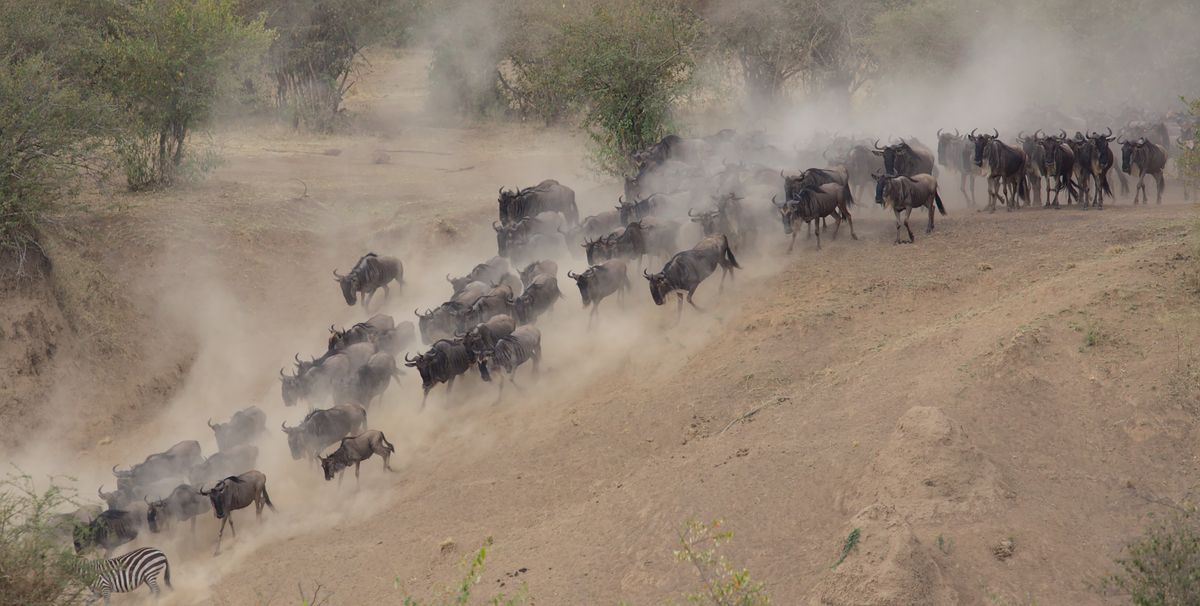
The Mara is home to the great wildebeest migration, when well over a million animals move across the plains in one of the largest gatherings of wildlife anywhere on Earth. And on a riding safari here, you are out in it. On horseback. Outfitters like Offbeat Riding Safaris and Safaris Unlimited have been running these since the early 1990s, using mobile tented camps that move with you as you cover up to 250 kilometers across the Mara over a week.
I will be honest about what this is. It is a serious ride. You need to be a genuinely experienced rider, comfortable at a fast canter and gallop, because when a herd starts moving, you move with it. But riders come back from this one changed. Galloping across the Mara with wildebeest thundering around you and not a fence or a road in sight is about as close to pure freedom as travel gets. If July through October lines up for you, that is prime migration season, and that is the trip.
"But I'm Not That Good a Rider Yet" - Ant's Nest, South Africa
I have said "experienced riders only" a couple of times now, and I know that just quietly disqualified a lot of you. So here is the good news.
You do not have to be an expert to do a riding safari. At Ant's Nest and Ant's Hill in South Africa's Waterberg region, the whole model is built for families and mixed-ability groups. It is a private, malaria-free big-game reserve, which means the pace can flex to whoever is riding. A confident rider can open up and canter while someone else walks quietly through the bush, all on the same outing. You still ride among giraffe, rhino, zebra, and wildebeest. You just get to do it at a pace that fits you.
This is the one I would book for a family, or for a couple where one person rides well and the other is starting from scratch. Same magic, gentler on-ramp.
The Practical Part (who, when, and how we book it)
A few honest logistics, because these trips reward planning:
Skill level matters more here than on any other kind of trip. The Okavango and the Masai Mara migration rides are for confident, fit riders who can canter and gallop and stay calm around wildlife. If that is not you yet, Ant's Nest or another private-reserve ride is where we start. I will always match you honestly. Putting a nervous rider on a Delta gallop helps no one.
When to go. Botswana's Okavango rides are best in the drier, higher-water months, roughly April to October. The Masai Mara migration is generally July to October. South Africa's Waterberg rides well for much of the year.
These book up early, and they are a specialist product. Riding safaris run small, a handful of guests at a time, and the best camps and dates go fast, often close to a year out. This is not a last-minute trip.
It is a real investment. Plan on roughly $800 to $1,300 or more per person, per night at the top camps, largely all-inclusive: riding, guiding, meals, drinks, sometimes the bush flights. You are paying for remoteness, tiny guest numbers, and world-class horses.
Let's figure out if this is your trip
This is exactly the kind of trip I love planning, because there is real matchmaking involved: the right camp, the right dates, the right ride for how you actually sit on a horse. Get it right and it is the trip of a lifetime. Get it wrong and you are either bored or a little terrified, and I am not going to let either of those happen to you.
So if the giraffe-cantering, migration-galloping version of Africa is calling you, email me. Tell me honestly how much riding you have done, and I will tell you exactly which of these is yours. And if you want to see how this ride stacks up against the rest, the full series recap lays out every trip sorted by skill level and dream.
Talk soon, Cindi